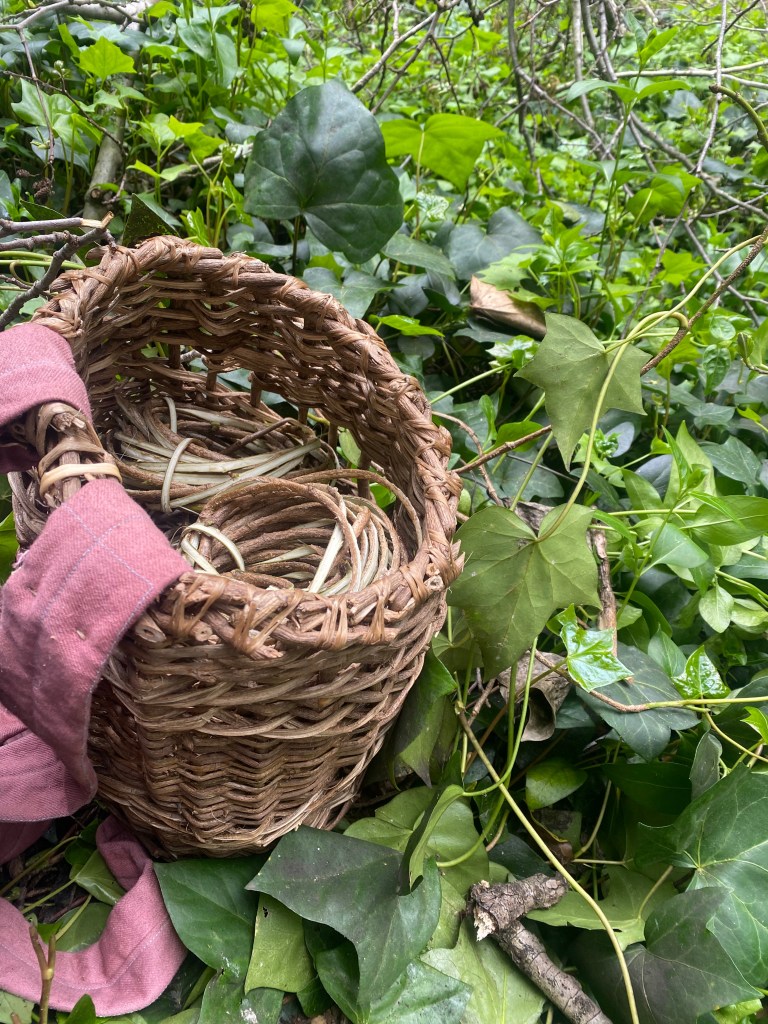
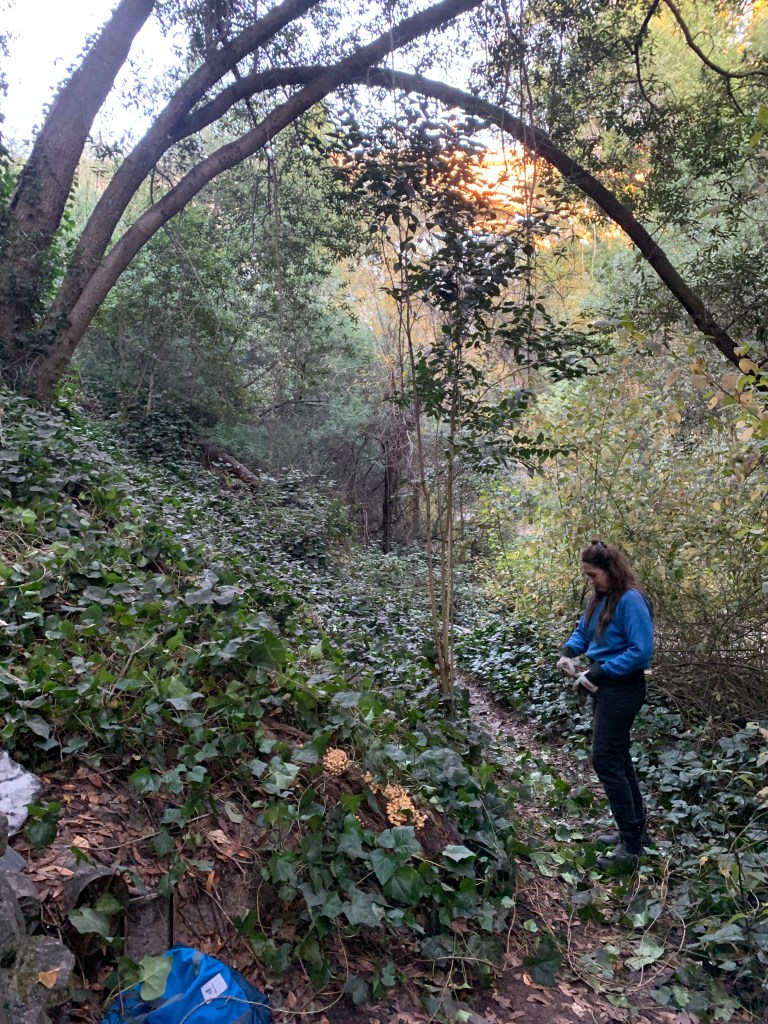
Sausal Creek Ivy League (SCIL) is an ongoing project of the Speculative Commoning Artist Collaborative (SCAC). We harvest the overabundant non-native plant English Ivy that grows ubiquitously along the Sausal Creek Watershed in Oakland, CA to create baskets, paper and other objects, art materials, tools and medicine. We see this project as a lab for learning the skill of commoning alongside other humans and non humans. We are curious about how the practice of art making in collaboration with the land can build human capacity to act as a keystone species within the community of life.
We host monthly harvest days and occasional basketry circles that are free to anyone who wishes to join! Click Here for more info about the SCIL harvest days!
Our Approach
We come from a place of curiosity rather than certitude about the best ways to support healing and biodiversity. We seek continual feedback and information through direct observation, reviewing many types of research (formal and noninstitutional), and engaging with diverse and expansive ways of knowing. We seek to move slowly at a pace that feels aligned with our approach and with an openness to experience the depth of our own grief about the loss and alienation created by extractive systems that do not support life.
Thoughts on English Ivy
English Ivy is wildly abundant in the beautiful and disturbed landscape of the Sausal creek watershed. It covers the hillsides and climbs up trees. It is a ruderal plant that thrives in disturbance. Disturbance caused by colonialism, private property regimes, extraction and urban development driven by capitalism. A primary facet of this disturbance is the forced removal and genocide of the humans who have tended and collaborated with this land since time immemorial. These disturbances fundamentally changed and continue to change many ecological factors that were a part of the more stable biodiverse ecology that existed before colonial and urban development, and created conditions in which displaced plants species such as English Ivy can thrive. All these factors have lead to a decrease in biodiversity in the watershed.
English Ivy is here, it has a huge presence, and it currently is functioning as a structural element of the canyon and watershed particularly along the steep hillsides. It *tethers the soil to the ground, preventing what would be massive erosion were it to be carte blanche removed in those areas. By controlling erosion it prevents turbidity in the creek that would contribute to the suffocation of the slowly recovering native rainbow trout species living in the Sausal Creek Watershed. It also offers cover and habitat for the dusky footed wood rat that makes its home along the canyon. Because of this, when we harvest English Ivy, we do not do it in the spirit of eradication or annihilation but with the goal of mutual benefit. Perhaps we are “keeping ivy in check” and/or perhaps we are collaborators in a ruderal landscape?
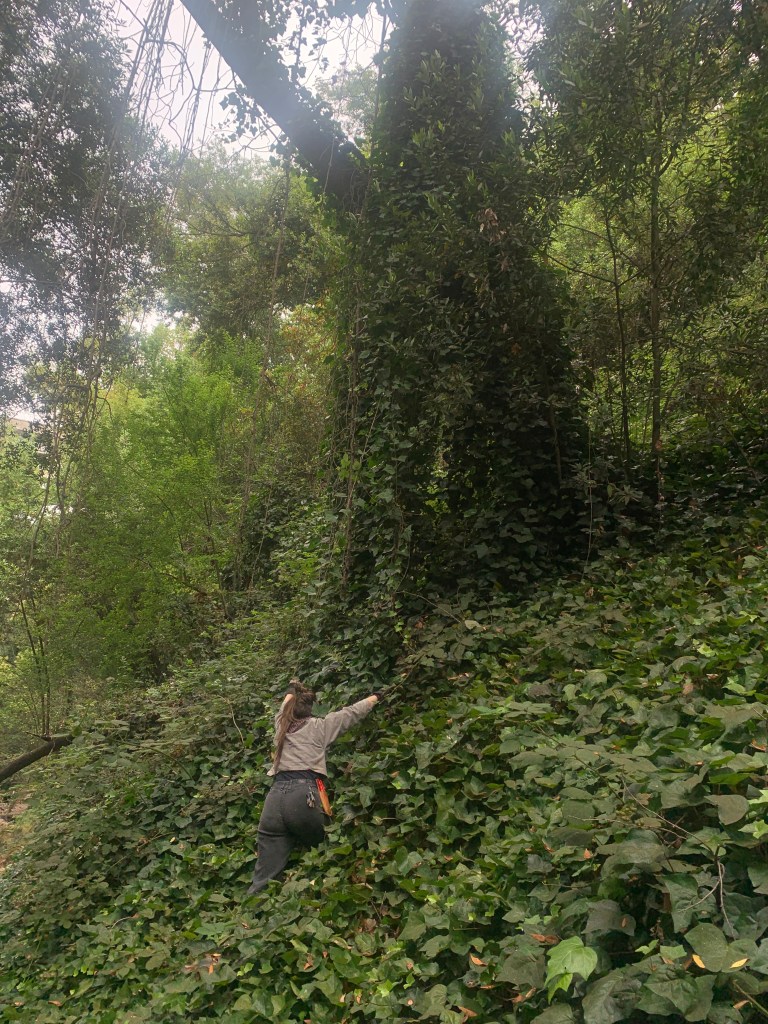
We’ve observed that while the ivy tethers the soil to the steep hillsides, it also climbs to the tops of trees seeking bright sunlight so that it can flower and fruit. Once it reaches the top it will drop long straight runners back down to the ground. We call this phenomena ‘ivy dragons’, because they remind us of giant graceful dragon wings sweeping down the hillsides. However, this climbing behavior often eventually pulls the tree down once the dangling vines reach the earth and set roots.
Our current praxis
Enter, the speculative commoners! For basket weaving we focus on harvesting the ‘ivy dragons’. The long straight ivy hanging down from the trees is choice material for weaving. Mostly free of roothair, clean, with long fibers that have been exposed to more sun than their ground runner counterparts. These vines are often up to 30 feet long! As we harvest the hanging vines, we strip the leaves and drop them around the base of the tree. We’ve observed that the leaves act as an effective mulch suppressing the ivy immediately around the tree’s base without disturbing the soil structure. And once we’ve removed all the ivy we can use, we girdle the ivy that is wrapped around the trunk, protecting the tree. An elegant solution that has multiple benefits!
We have also become familiar with ivy on a material level working with vines for basketry and papermaking. We’ve learned a lot about the details of what are the best ivy vines to harvest for which uses, where to find them and how to process them for use in our art practices and we seek to openly share this information with anyone interested!
At one site we harvested the hanging ivy dragons from a large oak (see below) After building a relationship with this spot we have continued to visit and planted California Hazel, a plant that can grow on a slope as an understory tree and hold down the soil as well! Hazel is a culturally significant basketry material in many places around the world and specifically this variety for indigenous folks here in California. We continue to return again and again to this spot to tend to the hazel babies. We hope that in the future these hazels can be used for basketry and also their nuts can be yummy nutritious food for humans and animals. We dream that these hazels and their progeny can be a beneficial presence in the watershed going into our shared uncertain future.
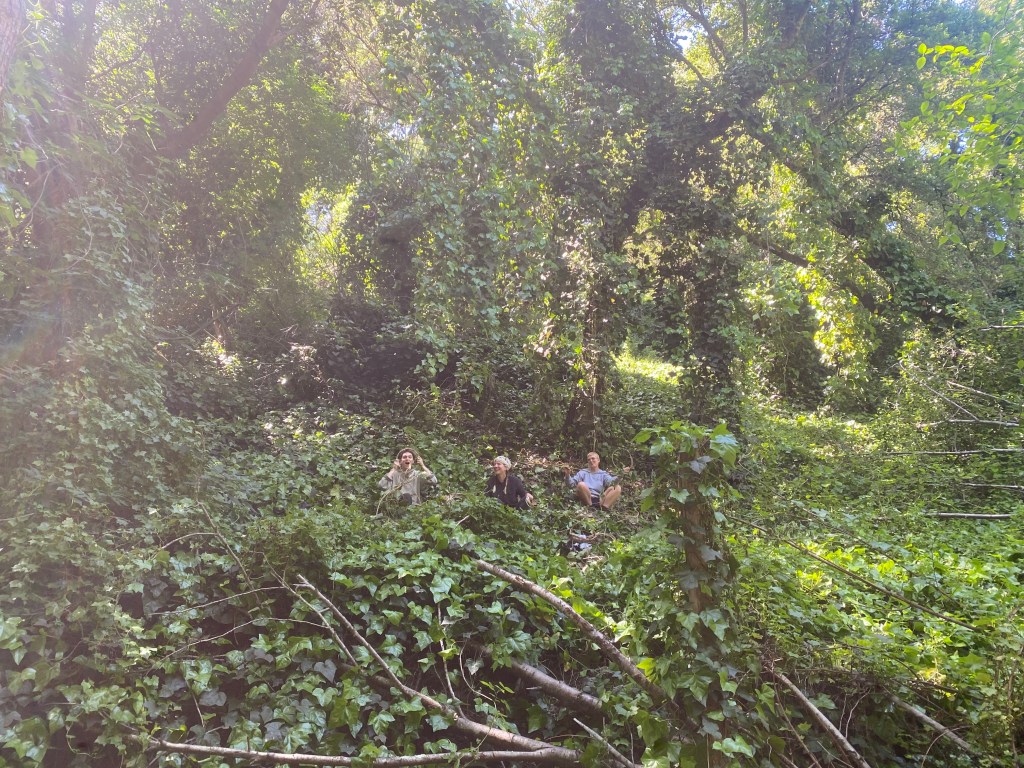
In some ways Ivy has also tethered us to the hillside ❤️🕸️
Click Here for more info about how to get involved with the SCIL project!

